
Free preview · no email required
Look inside the design system audit
before you spend $497.
A design system fails quietly. Nobody files a ticket saying the tokens are inconsistent — they just ship a slightly wrong button, and six months later there are four blues. This preview publishes the whole instrument: a sample assessment written end to end, the health scorecard with all sixty criteria, the complete contents, a fifteen-day engagement, every deliverable and the template layouts. No form, no email address.
A sample design system assessment
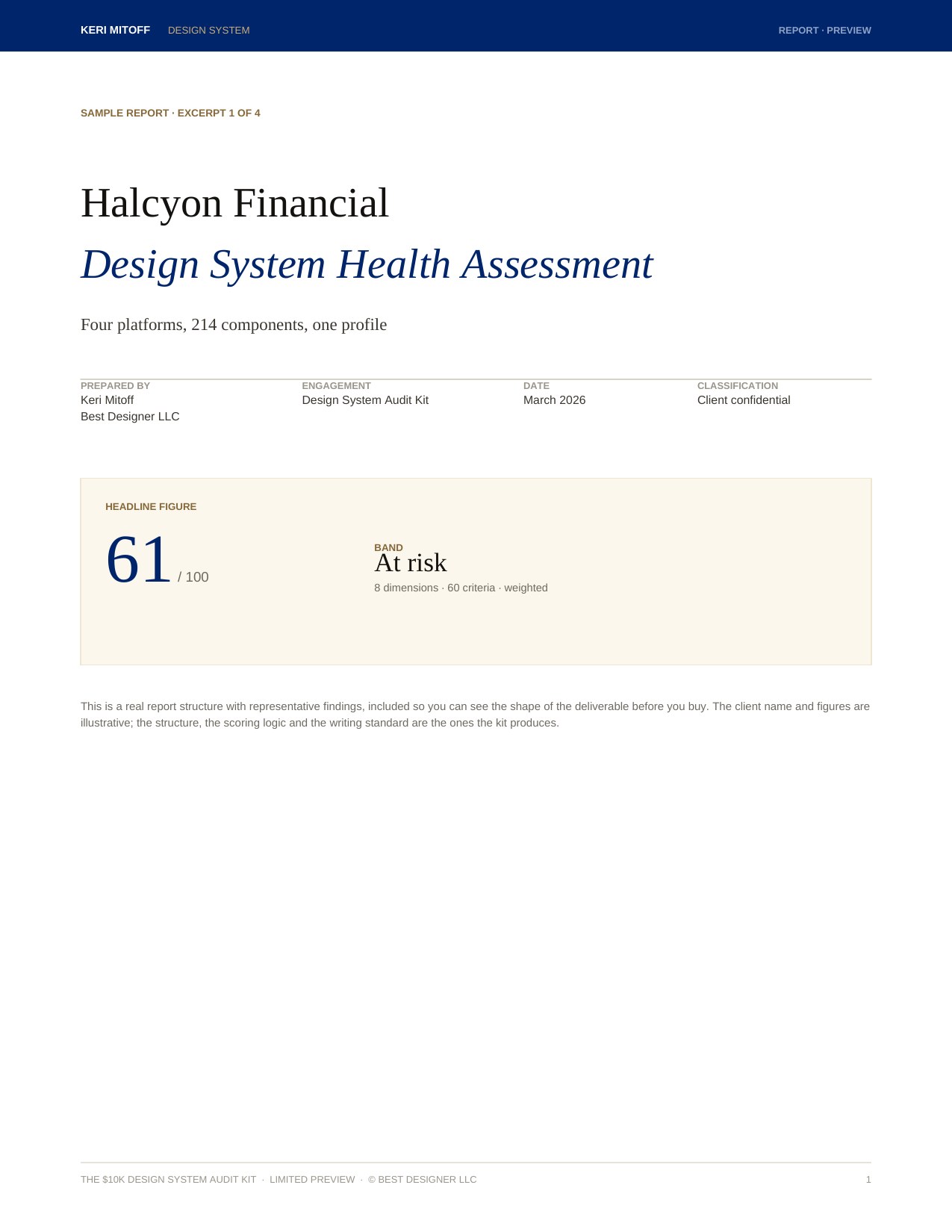
A complete assessment of a fictional four-platform system, written the way the kit writes it: a headline figure, a dimension profile that names the constraint, and five findings ranked by consequence rather than by ease.
- The cover, with the headline figure and the band it lands in
- Executive summary: what the assessment asks the client to decide
- The dimension profile, with the constraint named explicitly
- Five findings, each with evidence and consequence
- Scored against the same 60 criteria you get in the kit
This is a genuine excerpt. The full report structure — method, scope, limitations, recommendations and the roadmap appendix — follows the same shape inside the kit.
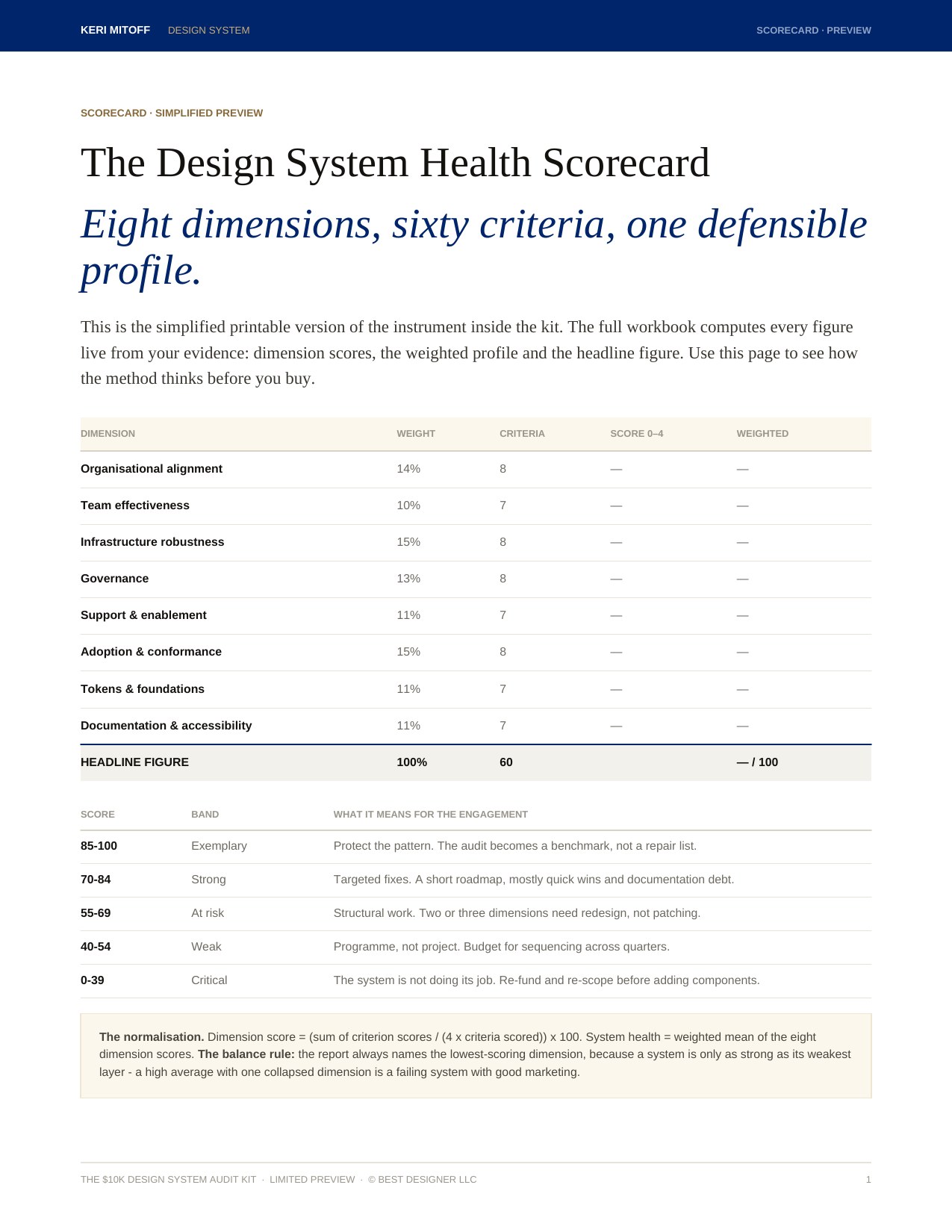
The simplified design system health scorecard
The instrument itself, printable, with all sixty criteria and the eight weighted dimensions that turn them into one defensible number.
- 8 dimensions with their real weights
- All 60 criteria, each with a 0–4 scale and an evidence field
- The 5 score bands and what each means for the engagement
- The normalisation formula, written out
- The published frameworks every criterion is traced to
Try it below. The interactive version scores a system in about a minute and shows you exactly how the weighted model behaves.
Try the model
Weighted · liveScore each dimension 0–4 and watch the weighted product health number move. This is the same arithmetic the workbook runs on 160 ratings.
Ten numbered PDFs
65 pages cover the method, scoring, evidence collection, and delivery.
- Start Here · 5 pages
- The Method · 8 pages
- Instrument Scorecard · 11 pages
- Scoring Workbook Guide · 5 pages
- Evidence Plan · 6 pages
- Engagement Workflow · 7 pages
- Sample Report · 8 pages
- Findings Library · 5 pages
- Proposal and SOW · 5 pages
- Stakeholder Kit · 5 pages
A sample client engagement
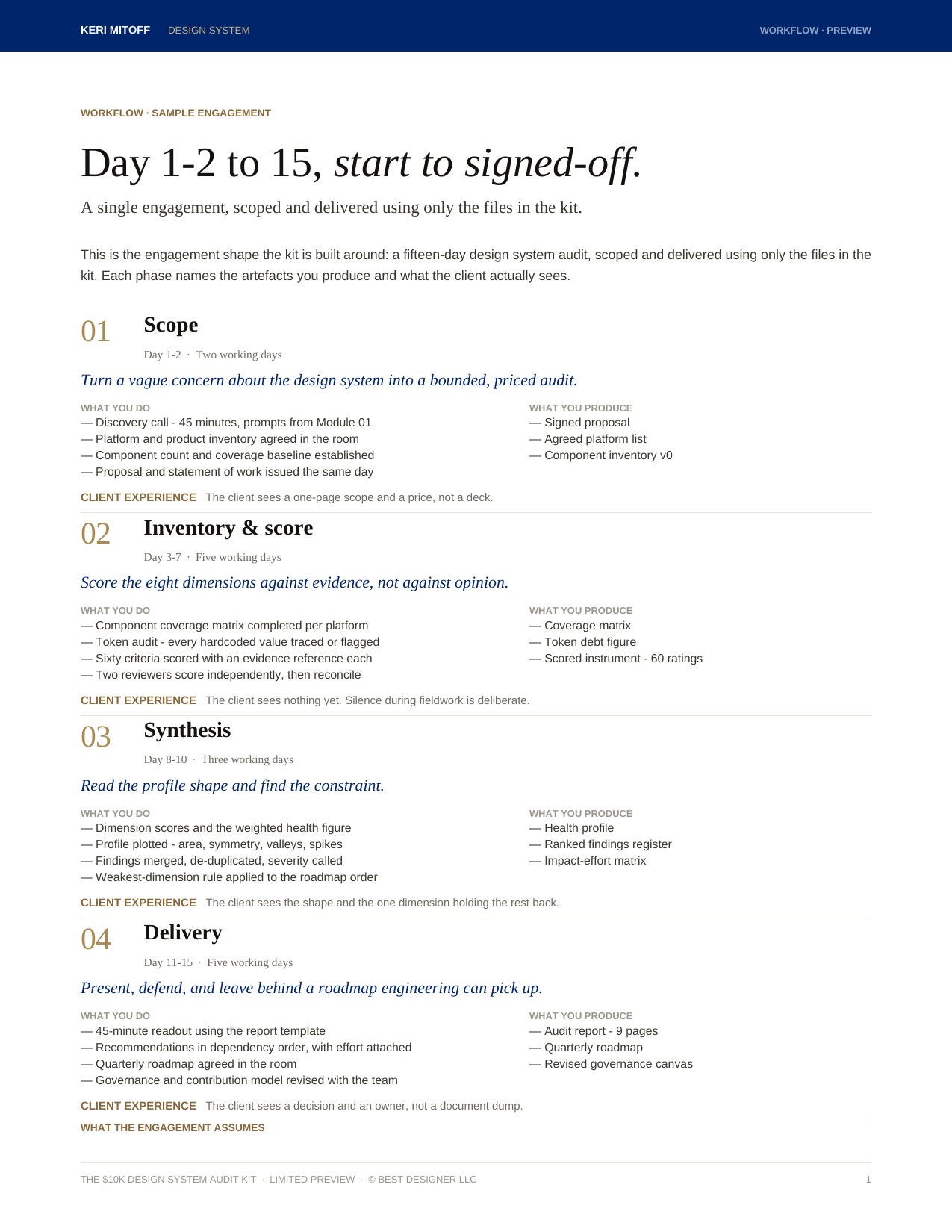
Fifteen working days, from a scoped system to an engineering-ready roadmap — the exact sequence the templates assume.
- 4 phases: scope, inventory & score, synthesis, delivery
- What you do and what you produce at each phase
- What the client sees, and when they see it
- The assumptions that make the timeline possible
This is the part most toolkits omit. Templates are easy; sequencing them so the engagement does not become a six-month programme is the hard part.
What comes with the PDFs
The kit contains 16 resource files plus a README with setup and rebranding guidance.
- Live Excel scoring workbook with seven tabs and incomplete-score warnings
- Editable Word proposal and statement of work
- Editable Word report template
- Editable PowerPoint executive readout
- Figma Design System Starter Library (.fig)
- Two-page quick reference for score anchors, bands, and weights
Five editable files
Use your own branding when you adapt these files for client work.
- Live Excel scoring workbook with seven tabs and incomplete-score warnings
- Editable Word proposal and statement of work
- Editable Word report template
- Editable PowerPoint executive readout
- Figma Design System Starter Library (.fig)
Ready when you are
You have seen the instrument.
Now score a system that is drifting.
One payment of $497 for the complete audit kit with 16 resource files plus the README, licensed for unlimited client and internal work. No subscription, no seat count, no video course.
- 65 pages across ten numbered PDFs, plus a two-page quick reference
- The Design System Health Scorecard — 60 criteria
- Complete sample report and editable templates
- Figma Design System Starter Library included
- Unlimited client and internal use
- Card checkout or a Wave invoice