
The KM Toolkit Series · Keri Mitoff
Turn Your Professional Expertise Into a High-Value Consulting Business.
Seven comprehensive, ready-to-use professional consulting systems designed to help experienced UX designers, product designers, design executives, consultants and agencies scope, price, evaluate and deliver high-value client engagements.
Not another online course. Not another generic template collection.
Get the methodologies, evaluation instruments, scoring engines, executive reports, proposals, workshop resources and client-ready deliverables you need to build a more structured, professional consulting practice.
Build on your expertise. Own your methodology. Deliver with confidence.
Seven professional consulting systems. One complete consulting business infrastructure.
Consulting engagement ROI calculator
Estimate what a consulting engagement could earn after delivery costs and how many engagements it would take to recover your toolkit investment.
Estimated return
ROI is estimated net earnings divided by total cost. The toolkit is charged once in the model. The starting values are illustrative, and estimates are before tax.
The catalogue
Seven systems and one bundle.
Each kit stands alone. Each is built to be used on a real engagement within a week of opening it. Choose the instrument that matches the problem in front of you, or take the bundle and stop buying them one at a time.
The $10K UX Audit Kit
Included$497 Design systemsDesign System Audit Kit
DS · 16 resources$497 AI transformationAI Business Transformation Kit
AI · 65 pp$797 Design leadershipExecutive UX Leadership Playbook
EX · 63 pp$497 Fractional practiceFractional Design Executive Toolkit
FX · 63 pp$697 HealthcareHealthcare UX Evaluation Toolkit
HC · 66 pp$597 Research operationsEnterprise UX Research Toolkit
RX · 65 pp$497 Bundle · six kitsComplete UX Consulting Business Bundle
BD · Six kits$1,997The $10K Design System Audit Kit
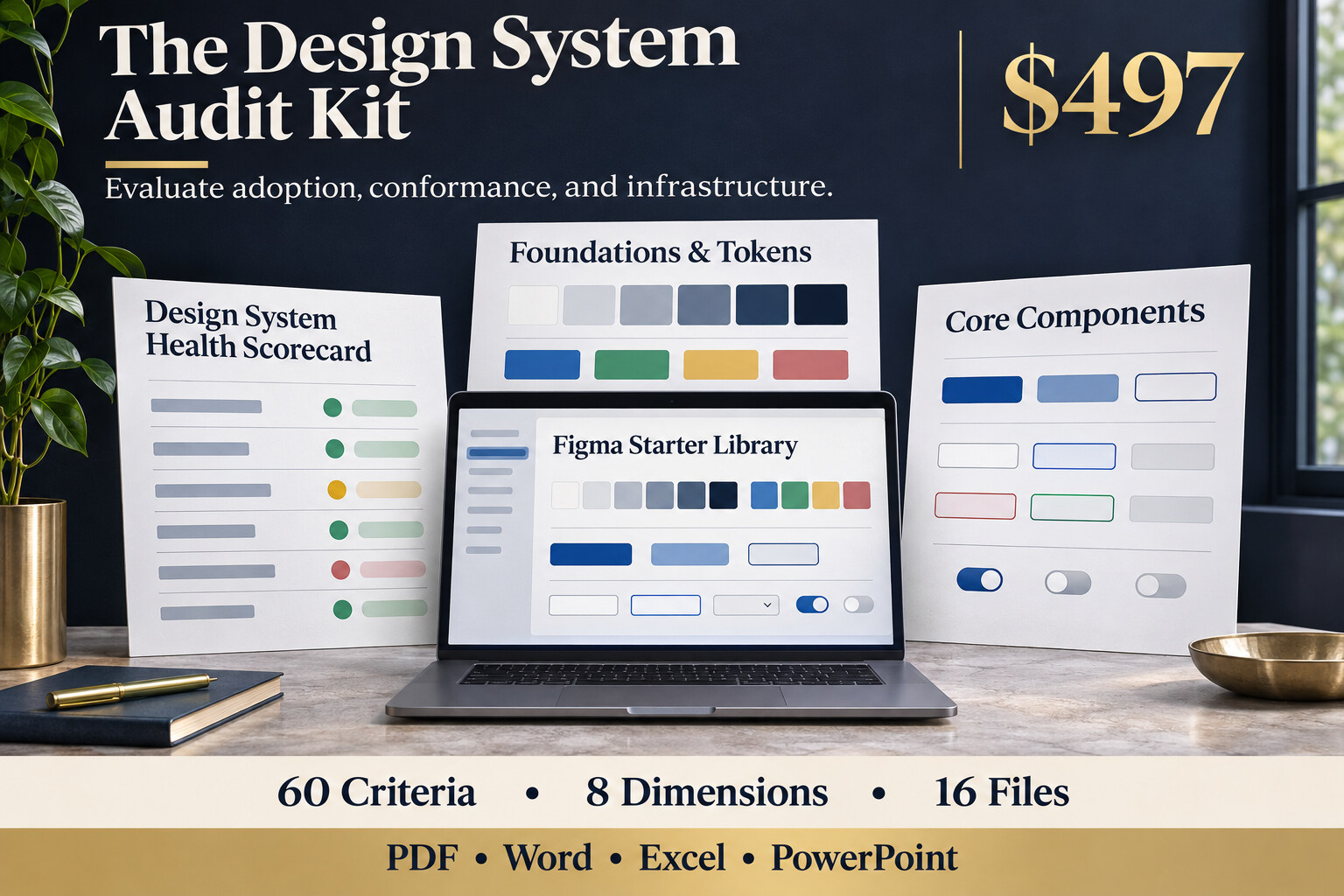
A complete, professional system for auditing a design system, scoring its health across sixty criteria, and presenting a prioritised remediation plan a leadership team will actually fund.
Most design systems do not fail because the components are ugly. They fail because nobody can say, with evidence, which parts are load-bearing and which parts are debt. This kit gives you the instrument, the register and the report to answer that question in ten working days.
- Pages in numbered PDFs
- 65
- Resource files
- 16 + README
- Editable files
- 5
- Scored criteria
- 60
One payment, no subscription. Your access key is emailed once payment clears. Invoice by card or bank transfer.
Who it is for
- Design system leads and design ops managers who inherited a system and need to know what state it is in.
- Product design leaders asked to justify design system headcount, tooling or a rebuild.
- Consultants and agencies selling design system audits, governance engagements or token migrations.
- Engineering managers who need a shared, evidence-based view of component and token debt.
The instrument
60 criteria across eight dimensions
Foundations & Tokens8
- Colour tokens are defined and named semantically, not by hue
- A semantic alias layer sits between primitives and components
- Type scale is defined as tokens with line-height and tracking pairs
- Spacing scale is tokenised and used consistently in layout
- Radius and elevation tokens are defined and applied
- Motion and duration tokens exist and respect reduced-motion
- Breakpoints are tokenised and documented
- Light and dark themes achieve visual parity
Components & Patterns8
- A complete component inventory exists and is current
- Variant coverage matches real product usage
- All interactive states are specified: default, hover, focus, active, disabled, error
- Composition rules define how components nest
- Patterns for common flows are documented, not just primitives
- Deprecated components are marked and have migration paths
- Component APIs are consistent across the library
- Responsive behaviour is specified per component
Documentation8
- A getting-started path exists for a new team
- Usage guidance explains when to use and when not to
- Do and don't examples are visual, not prose-only
- Content and microcopy guidance is included
- Accessibility notes sit beside each component
- Copy-paste code snippets are current
- A changelog is maintained and readable
- Documentation is searchable and findable
Governance & Contribution8
- A named owner exists for the system
- A contribution process is published and used
- Review service levels are defined and met
- An RFC or proposal process exists for new patterns
- Semantic versioning is applied to releases
- A deprecation policy exists with notice periods
- Design decisions are logged with rationale
- Contributing teams are represented in governance
Adoption & Measurement7
- Adoption is measured, not assumed
- Component coverage across product surfaces is known
- Exceptions and overrides are logged
- A migration backlog exists and is prioritised
- Usage analytics or telemetry inform the roadmap
- Team satisfaction with the system is surveyed
- Return on investment is reported to leadership
Accessibility8
- Colour tokens pass contrast at every intended pairing
- Focus states are defined, visible and consistent
- Keyboard interaction patterns are documented per component
- Screen reader expectations are annotated
- Target sizes meet minimum touch requirements
- Reduced-motion behaviour is specified
- Form error and validation patterns are accessible
- Accessibility audits run on a fixed cadence
Code & Implementation Parity7
- Design and code share a single source of truth
- Tokens are delivered through an automated pipeline
- Component parity between design and code is tracked
- Visual regression or snapshot testing is in place
- Performance budgets exist for component bundles
- Framework coverage matches the technology estate
- Release cadence is predictable and communicated
Brand & Visual Coherence6
- The system reflects current brand standards
- An icon system exists with consistent construction
- Illustration and imagery guidance is documented
- Tone of voice is codified alongside visuals
- Multi-brand or white-label needs are supported
- Visual quality assurance happens before release
Ten numbered PDFs
Start Here
5 pages
The Method
8 pages
Instrument Scorecard
11 pages
Scoring Workbook Guide
5 pages
Evidence Plan
6 pages
Engagement Workflow
7 pages
Sample Report
8 pages
Findings Library
5 pages
Proposal and SOW
5 pages
Stakeholder Kit
5 pages
What you receive
- Live Excel scoring workbook with seven tabs and incomplete-score warnings
- Editable Word proposal and statement of work
- Editable Word report template
- Editable PowerPoint executive readout
- Figma Design System Starter Library (.fig)
- Two-page quick reference for score anchors, bands, and weights
- README with setup and rebranding guidance
The $15K AI Business Transformation Kit
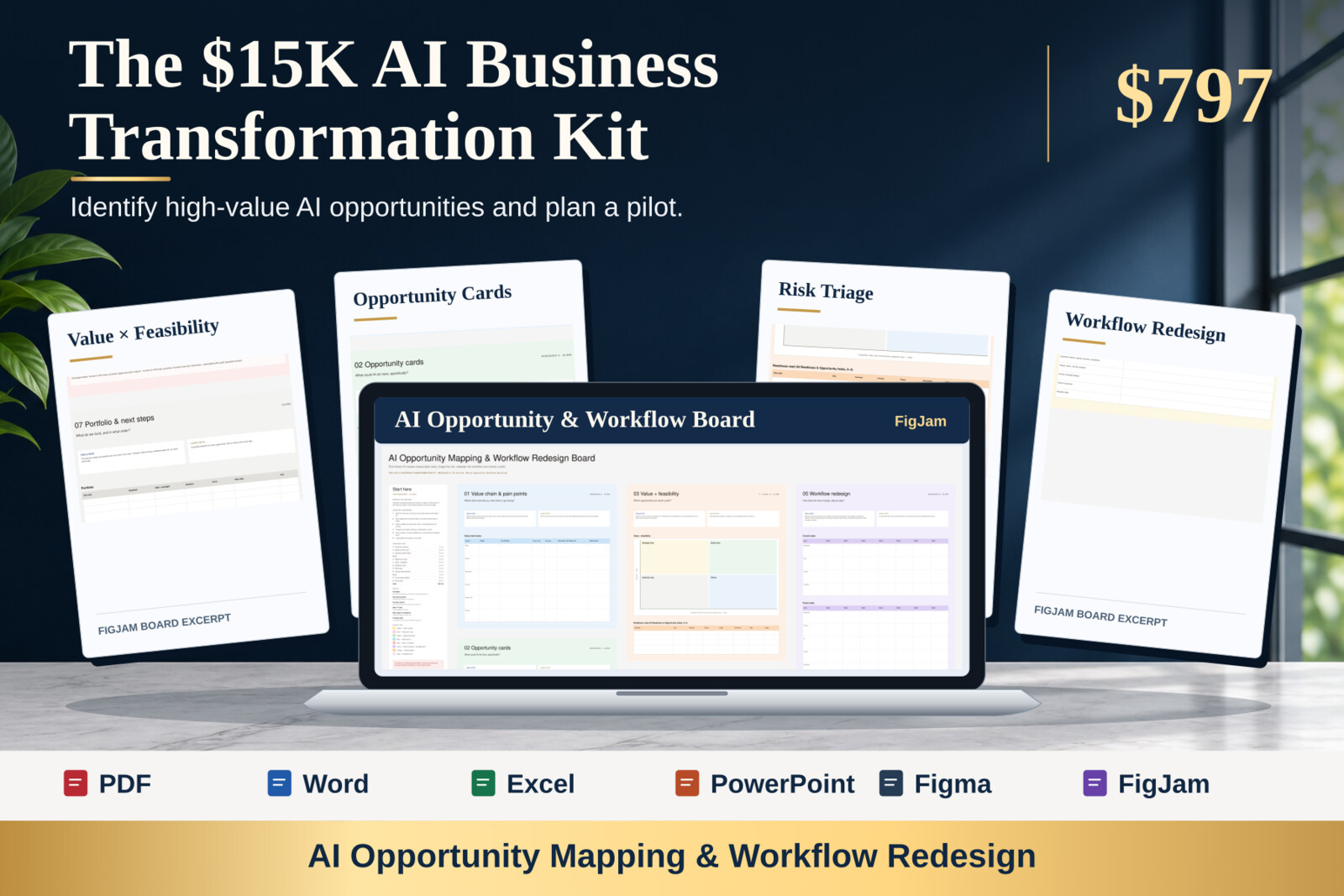
A consulting-grade system for finding where AI actually creates value, proving it with a measured pilot, and taking it through governance to rollout — without the hype deck.
Every organisation now has an AI strategy. Very few have an AI portfolio. The difference is a repeatable method for scoring opportunities against value and feasibility, sizing the risk, designing the workflow change, and proving the result before you scale the spend.
- Designed pages
- 65
- Editable files
- 38
- Modules
- 9
- Scored criteria
- 48
- Deliverables
- 10
One payment, no subscription. Your access key is emailed once payment clears. Invoice by card or bank transfer.
Who it is for
- Consultants and advisors selling AI transformation engagements at five and six figures.
- Product and operations leaders asked to 'do something with AI' and needing a defensible plan.
- Transformation, innovation and strategy teams building an AI portfolio.
- Design and research leaders responsible for the human side of AI-enabled workflows.
The instrument
48 criteria across six dimensions
Data Readiness8
- Critical data sources are identified and catalogued
- Data ownership and stewardship are assigned
- Data quality is measured, not assumed
- Access rights and permissions are mapped
- Retention and deletion policies are defined
- Sensitive data is classified
- Data lineage is traceable for regulated outputs
- Historical data is sufficient to evaluate model performance
Technical Infrastructure8
- Integration points with existing systems are known
- Model hosting approach is decided: vendor, private or hybrid
- Latency and availability requirements are documented
- Cost per inference or per transaction is modelled
- Monitoring and drift detection are planned
- Fallback behaviour is defined for model failure
- Environments for testing and production are separated
- Security review covers third-party model providers
Process & Workflow8
- Target workflows are mapped end to end
- Handoff points between human and machine are explicit
- Exception and escalation paths are designed
- Volume and frequency of the task are quantified
- Cycle time and rework are baselined
- Change impact on adjacent roles is assessed
- Workflow redesign precedes tool selection
- Success measures are defined before launch
People & Skills8
- Roles affected by the change are identified
- Skill gaps are assessed honestly
- Training is designed for the actual workflow, not the tool
- Champions or super-users are named per team
- Concerns and resistance are surfaced early
- Job architecture implications are considered
- Support model for day-two operations is defined
- Leadership sponsorship is visible and named
Governance, Risk & Compliance8
- Applicable regulation is identified by jurisdiction
- A risk classification exists per use case
- Human oversight requirements are specified
- Bias and fairness testing is planned where relevant
- Explainability requirements are defined for decisions
- Audit logging and traceability are in place
- Vendor contract terms cover data use and liability
- An AI use policy exists and is communicated
Value & Business Case8
- Value is quantified in money, time or risk reduction
- Baseline metrics are captured before the pilot
- Total cost of ownership includes people and change
- Benefits are attributed realistically, not optimistically
- Payback period is modelled with a range
- Opportunity cost of not acting is stated
- Portfolio balance across quick wins and bets is deliberate
- A stage-gate decision model governs continued funding
The modules
Start Here
The transformation method, the stage gates, and how to run the kit.
Opportunity Mapping
Find and frame candidate use cases across the value chain.
Readiness & Risk
Score data, infrastructure, people and governance readiness.
Use Case Prioritisation
Plot value against feasibility; build a funded portfolio, not a wish list.
Workflow Redesign
Redesign the work before you buy the tool — human and machine handoffs.
Governance & Ethics
Risk classification, oversight, policy and vendor due diligence.
Pilot Design & Measurement
Design a pilot that can fail honestly, with baselines and stage gates.
Business Case & Deck
Build the executive case: value, cost, risk, payback and ask.
Rollout & Change
Scale, train, support and measure adoption after launch.
What you receive
- AI Readiness & Opportunity Index — 48 criteria, weighted, with scoring guidance
- Opportunity Map — candidate use cases by function, value and effort
- Prioritisation Matrix — value vs feasibility with a funded portfolio view
- Workflow Redesign canvas — current state, future state, handoffs and exceptions
- Risk Classification & Governance pack — oversight levels, policy outline, vendor checklist
- Pilot Charter — hypothesis, baseline, success thresholds and kill criteria
- Business Case model — TCO, benefits, payback range and sensitivity
- Executive transformation deck, editable
- Rollout and change management plan with adoption measures
- Scoping worksheet, proposal and statement of work for the engagement
The Executive UX Leadership Playbook
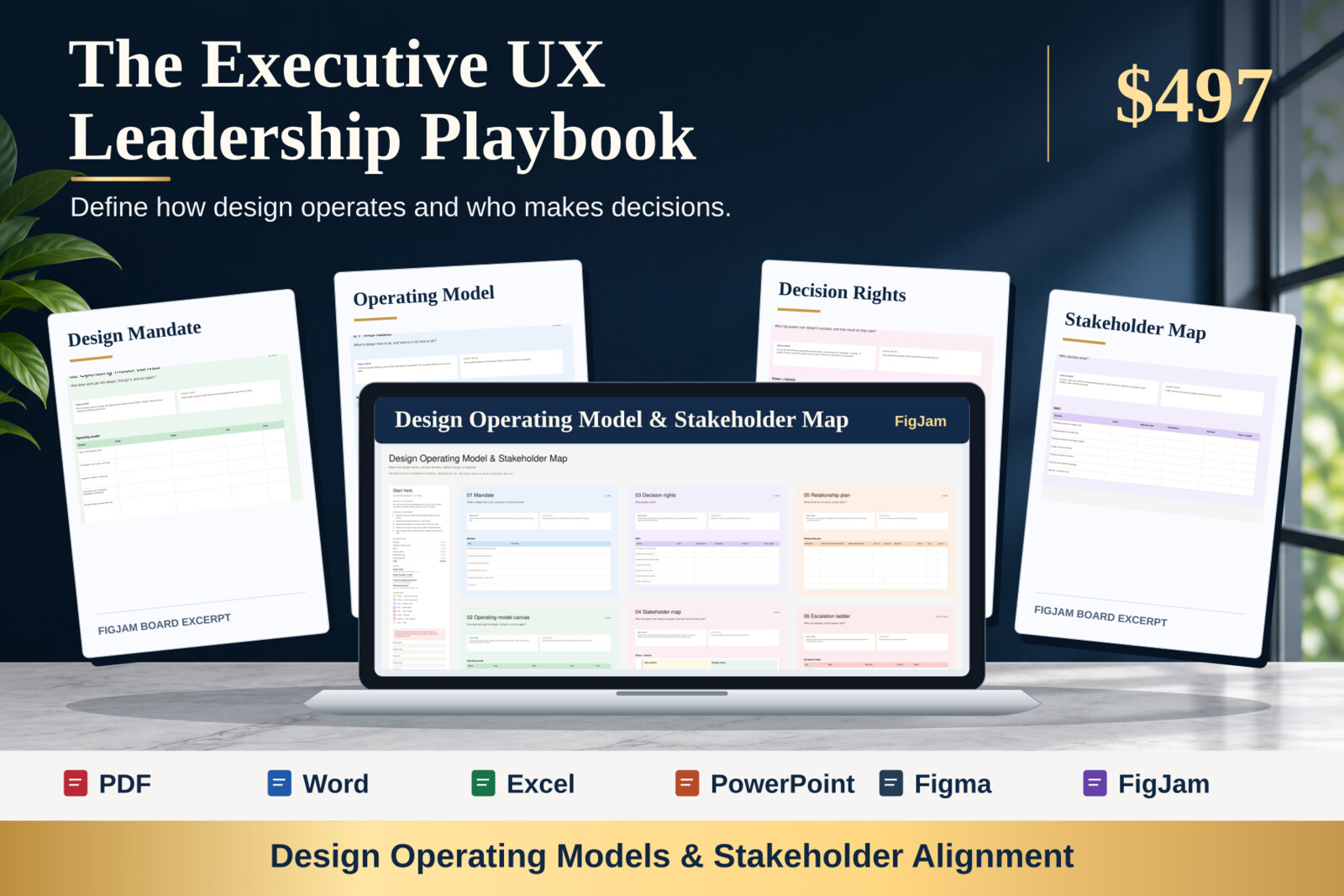
The operating manual for a design leader with a seat at the table: the first ninety days, the operating model, the maturity story, and the language to defend the budget.
Moving from running design work to running a design function is a different job. It is not more craft. It is operating model, org design, executive communication, and the political skill to make design legible to a CFO. This playbook is that job, written down.
- Designed pages
- 63
- Editable files
- 30
- Modules
- 9
- Scored criteria
- 40
- Deliverables
- 10
One payment, no subscription. Your access key is emailed once payment clears. Invoice by card or bank transfer.
Who it is for
- Newly appointed design directors, heads of design and VPs of design.
- Senior designers stepping into their first leadership role.
- Design leaders in an organisation where design is not yet understood.
- Founders and product executives building a design function from scratch.
The instrument
40 criteria across five dimensions
Strategy & Mandate8
- Design has a written mandate agreed with the executive team
- A multi-year design strategy exists and is resourced
- Design priorities connect to company strategy explicitly
- There is a clear point of view on where design competes
- Design is represented in planning cycles, not consulted after
- Success measures for the function are defined
- Trade-offs and non-goals are documented
- The function has a narrative leaders can repeat
Organisation & Talent8
- The org structure matches how work actually flows
- Career ladders exist and are used in reviews
- Hiring bar is defined and applied consistently
- Specialisms are balanced against generalists deliberately
- Retention risks are known and addressed
- Performance management is fair, documented and timely
- Contractor and agency mix is intentional
- Succession and coverage exist for key roles
Operating Model8
- Intake and prioritisation are transparent
- Capacity is planned against a roadmap, not ad hoc
- Design participates in discovery, not just delivery
- Critique and quality review are structured
- Design system ownership is clear
- Research is connected to decisions
- Cross-functional rituals are defined and respected
- Documentation and handoff standards exist
Influence & Governance8
- Design has decision rights where it should
- Executive stakeholders are mapped and engaged
- Design speaks in business outcomes, not artefacts
- Budget and headcount requests are evidence-based
- Design handles conflict and escalation well
- Design is visible in company communications
- External credibility is built through speaking or writing
- Allies in product, engineering and finance are cultivated
Measurement & Maturity8
- Design quality is measured, not asserted
- Business impact is attributed credibly
- Design maturity is assessed on a fixed cadence
- Metrics are reported in a format executives read
- Research and usability data inform the roadmap
- Cost of design debt is understood
- Investment cases include a measurement plan
- The function learns from post-mortems
The modules
Start Here
How to use the playbook in your first week, month and quarter.
The First 90 Days
A week-by-week plan: listen, diagnose, decide, communicate.
Operating Model
Intake, capacity, rituals and decision rights — design the function's engine.
Maturity Assessment
Score the function across five dimensions and build the improvement case.
Executive Communication
Write and speak so a CFO, CTO and CEO all hear the same value.
Budget & Headcount
Build an evidence-based investment case that survives finance review.
Hiring & Team Building
Ladders, scorecards, interview loops and the first-year team plan.
Metrics & Reporting
A design scorecard leadership actually reads, monthly and quarterly.
Influence Without Authority
Stakeholder maps, escalation, and the politics of design decisions.
What you receive
- Design Leadership Operating Assessment — 40 criteria with scoring and interpretation
- First 90 Days plan — week-by-week with stakeholder and diagnostic milestones
- Operating Model canvas — intake, capacity, rituals and decision rights
- Maturity Assessment report template — evidence, score, narrative, ask
- Executive communication pack — one-page narrative, board slide, talking points
- Budget and headcount model — cost, capacity, value and payback
- Hiring pack — role scorecards, interview loops, calibration guide
- Design scorecard — monthly and quarterly reporting templates
- Stakeholder influence map and escalation playbook
- Quarterly business review deck, editable
The Fractional Design Executive Toolkit
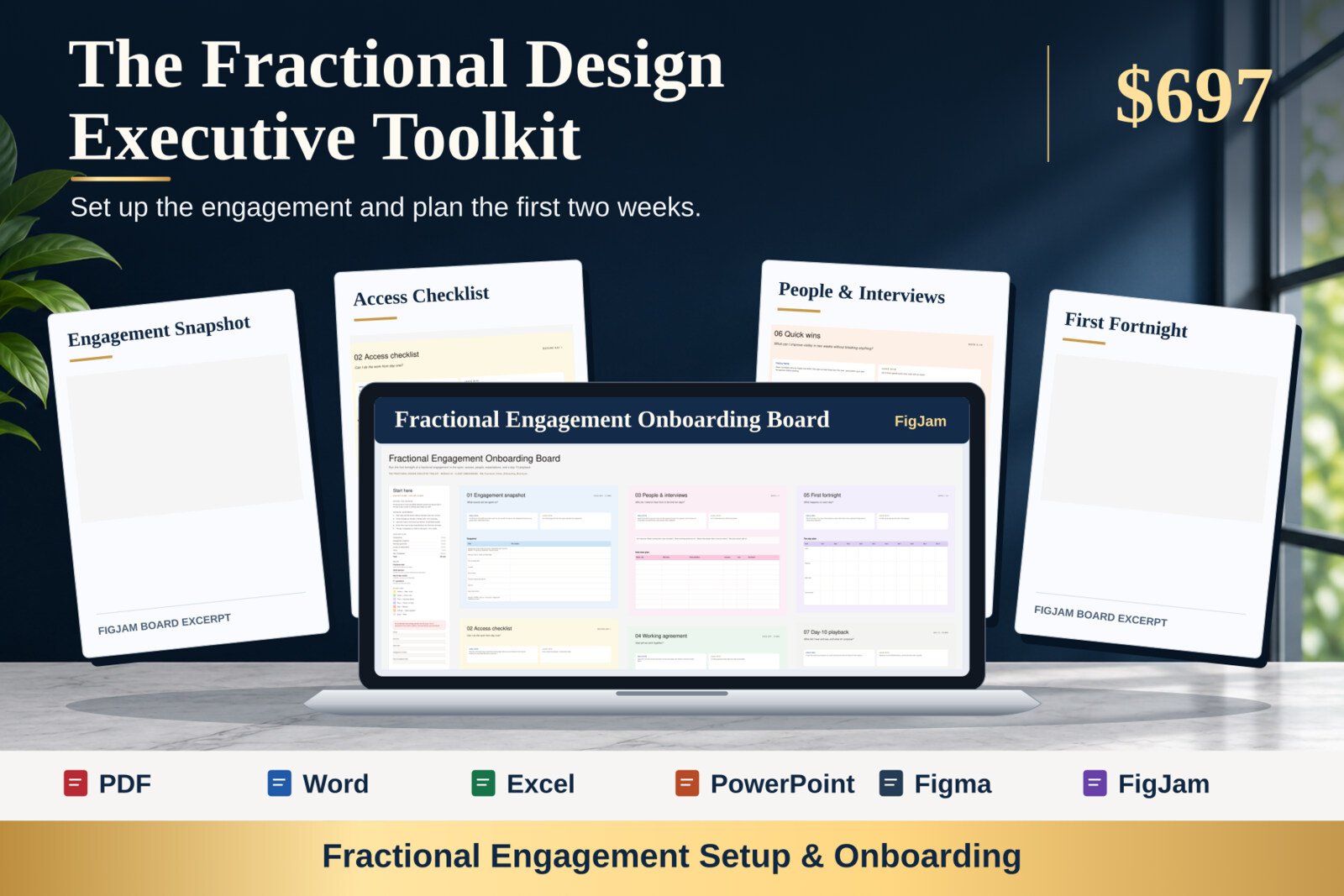
Everything you need to sell, run and renew fractional design leadership engagements: positioning, pricing, contracts, cadence and the exit that earns the referral.
Fractional work fails in predictable ways. The scope drifts into staff augmentation, the rate is set by the day instead of by the outcome, and the engagement ends without a handover. This toolkit is the commercial and operational spine that prevents all three.
- Designed pages
- 63
- Editable files
- 28
- Modules
- 9
- Scored criteria
- 30
- Deliverables
- 10
One payment, no subscription. Your access key is emailed once payment clears. Invoice by card or bank transfer.
Who it is for
- Senior design leaders going independent or adding fractional work to consulting.
- Consultants whose engagements keep turning into unpaid advisory.
- Boutique studios selling embedded design leadership.
- Design leaders who want a repeatable, productised fractional offer.
The instrument
Five engagement models with pricing and scope boundaries
Diagnostic Sprint6
- Fixed two to three week entry engagement
- Scope: audit, interviews, maturity read, recommendation
- Deliverable: findings report and 90-day plan
- Priced as a fixed fee, never by the hour
- Purpose: qualify the client and de-risk the retainer
- Exit: proposal for ongoing leadership
Embedded Fractional Lead6
- Two to four days per week for a defined period
- Scope: run the design function, own the operating model
- Deliverable: team, rituals, roadmap and reporting
- Priced as a monthly retainer with a minimum term
- Purpose: cover a leadership gap or a transition
- Exit: hire and hand over, or convert to advisory
Advisory Retainer6
- One to two days per month, scheduled in advance
- Scope: counsel, reviews, escalation support
- Deliverable: monthly written recommendations
- Priced monthly, with a cap on availability
- Purpose: keep a senior brain on call
- Exit: annual review or upgrade to embedded
Programme Leadership6
- Outcome-based engagement with a defined end state
- Scope: a system, a redesign, an org transformation
- Deliverable: the outcome plus the operating capability
- Priced as a fixed programme fee in stages
- Purpose: deliver a specific, board-visible result
- Exit: capability transfer and closeout report
Board & Executive Counsel6
- Quarterly cadence with the executive or board
- Scope: independent assessment and challenge
- Deliverable: written brief before each session
- Priced per quarter, annual commitment
- Purpose: independent judgement at the top
- Exit: rolling annual renewal
The modules
Start Here
The fractional model, the economics, and how to use the kit.
Positioning & Niche
Define the problem you solve, for whom, and why you are the obvious choice.
Engagement Models & Pricing
Five models, rate architecture, and how to stop selling days.
Discovery & Diagnostic
A paid diagnostic that qualifies the client and sells the retainer.
SOW & Contract Pack
Scope, assumptions, change control, IP, termination and payment terms.
Client Onboarding
The first two weeks: access, stakeholders, expectations, quick wins.
Delivery Cadence
Weekly rhythm, monthly reporting, and the quarterly business review.
Renewal & Expansion
Evidence-based renewal conversations and scope expansion.
Exit & Handover
Close cleanly, transfer capability, and convert to referral.
What you receive
- Positioning statement and ideal client profile worksheets
- Five engagement models with scope boundaries and inclusion/exclusion lists
- Rate architecture and pricing calculator — day, week, retainer and outcome
- Paid diagnostic offer — scope, price, agenda and report template
- SOW and contract pack — MSA outline, SOW, change order, IP and termination clauses
- Client onboarding checklist and first-fortnight plan
- Delivery cadence pack — weekly agenda, monthly report, QBR deck
- Renewal and expansion scripts with evidence templates
- Exit and handover checklist with capability transfer plan
- Proposal template and pitch deck, editable
The Healthcare UX Evaluation Toolkit
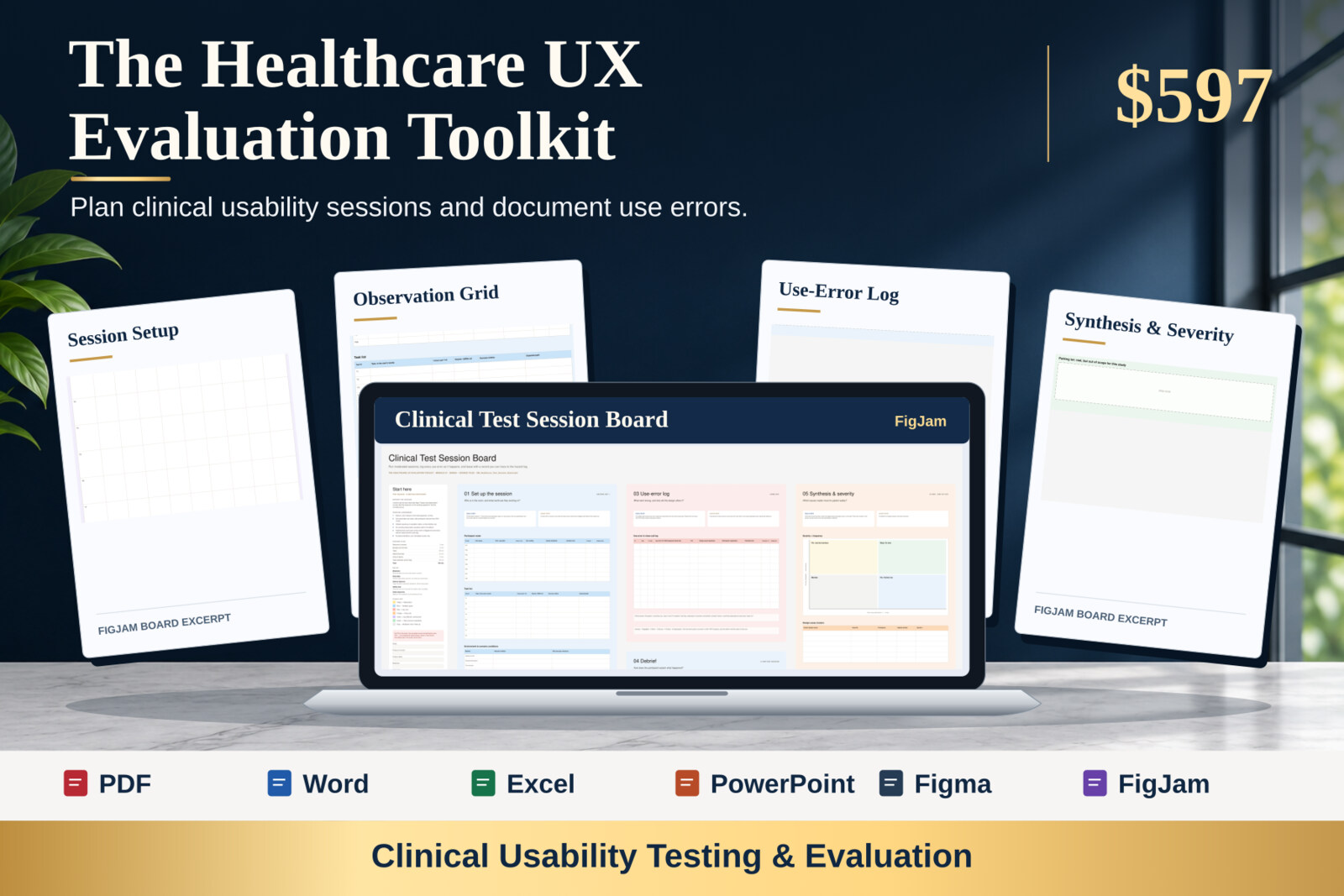
A clinical-context evaluation system: patient safety, clinical workflow fit, health literacy, accessibility and the regulatory evidence a healthcare buyer will ask for.
Healthcare interfaces are not harder to design because clinicians are difficult. They are harder because an error has a body count, the workflow is interrupt-driven, and the regulator wants evidence. This toolkit evaluates against those realities, not generic heuristics.
- Designed pages
- 66
- Editable files
- 34
- Modules
- 9
- Scored criteria
- 56
- Deliverables
- 10
One payment, no subscription. Your access key is emailed once payment clears. Invoice by card or bank transfer.
Who it is for
- UX and product leaders working in health systems, payers, medtech and digital health.
- Consultants selling into healthcare who need credible clinical evaluation language.
- Clinical informatics and quality teams evaluating patient-facing or clinician-facing software.
- Designers entering healthcare from another sector who need the domain frame fast.
The instrument
56 criteria across seven dimensions
Patient Safety & Error Risk8
- High-risk actions are identified and have confirmation safeguards
- Error-prone inputs have constraints, defaults and validation
- Critical values are visually and semantically distinguishable
- Look-alike and sound-alike confusions are designed out
- Undo and recovery exist for consequential actions
- Failure modes are analysed, not just listed
- Alerts are prioritised and not fatiguing
- Handoff and transition points are explicitly designed
Clinical Workflow Fit8
- The real workflow is observed, not assumed
- Interruption and multitasking are designed for
- Time-to-task is measured against clinical pressure
- Documentation burden is assessed
- Role-based views match actual responsibilities
- Workarounds used by staff are documented
- Integration with existing systems is evaluated
- Shift and handover patterns are supported
Accessibility & Health Literacy8
- WCAG 2.2 AA conformance is evaluated, not assumed
- Plain-language standards are applied to patient content
- Reading level is measured
- Translation and interpretation needs are supported
- Cognitive load is appropriate for stress and low literacy
- Screen reader and keyboard use is tested
- Colour is never the sole carrier of meaning
- Low-bandwidth and older-device use is supported
Regulatory & Privacy8
- Applicable regulation is identified per market
- PHI handling and minimum necessary access are evaluated
- Consent and authorisation flows are clear
- Audit trails exist for record access and change
- Clinical decision support claims are assessed for device status
- Data retention and deletion are specified
- Breach and incident paths are documented
- Vendor and business associate obligations are reviewed
Data Display & Decision Support8
- Numeric precision matches clinical need
- Trends and baselines are shown, not just point values
- Uncertainty and data provenance are visible
- Recommendations explain their basis
- Overrides are possible and recorded
- Dashboards answer a decision, not a curiosity
- Units and reference ranges are unambiguous
- Comparisons across time and cohort are supported
Patient-Facing Digital8
- Scheduling and access flows are evaluated end to end
- Cost and coverage information is legible before commitment
- Results and records are explained, not just displayed
- Care navigation is clear at each step
- Accessibility on mobile is tested with real users
- Trust signals and privacy notices are understandable
- Error recovery does not require a phone call
- Equity of access across populations is considered
Equity & Language Access8
- Populations served are identified and represented in testing
- Language access meets legal and practical need
- Cultural assumptions in content are reviewed
- Digital literacy range is accommodated
- Disability access is tested with assistive technology
- Rural and low-connectivity contexts are supported
- Cost barriers in the digital path are surfaced
- Findings are disaggregated where data allows
The modules
Start Here
The healthcare evaluation frame, regulatory map and how to run the kit.
Regulatory Landscape
HIPAA, HITRUST, FDA device status, WCAG, Section 508, EU MDR and GDPR in practice.
Clinical Workflow Mapping
Observe and map real workflows, interruptions, roles and handoffs.
Safety & Error Risk
FMEA-style failure mode analysis for high-risk interface actions.
Accessibility & Health Literacy
WCAG 2.2, plain language, reading level and language access.
Usability Evaluation
Clinical-context study design, moderation and task selection.
EHR & Portal Evaluation
Evaluate clinician-facing systems and patient portals against the scorecard.
Clinical Stakeholder Report
Write findings for clinicians, quality leads and executives at once.
Remediation Roadmap
Prioritise by patient risk and effort, with owners and verification.
What you receive
- Clinical UX Safety & Access Scorecard — 56 criteria with clinical anchoring
- Regulatory applicability map — by market, product type and data flow
- Clinical workflow map — roles, interruptions, handoffs and workarounds
- Failure Mode & Effects worksheet — severity, likelihood, detection, mitigation
- Accessibility and health literacy test protocol — tasks, tools, thresholds
- Usability study pack — screener, consent, moderator guide, analysis frame
- Findings report template — clinical, operational and executive audiences
- Risk-prioritised remediation roadmap with verification steps
- Clinical stakeholder presentation deck, editable
- Scoping worksheet, proposal and statement of work
The Enterprise UX Research Toolkit
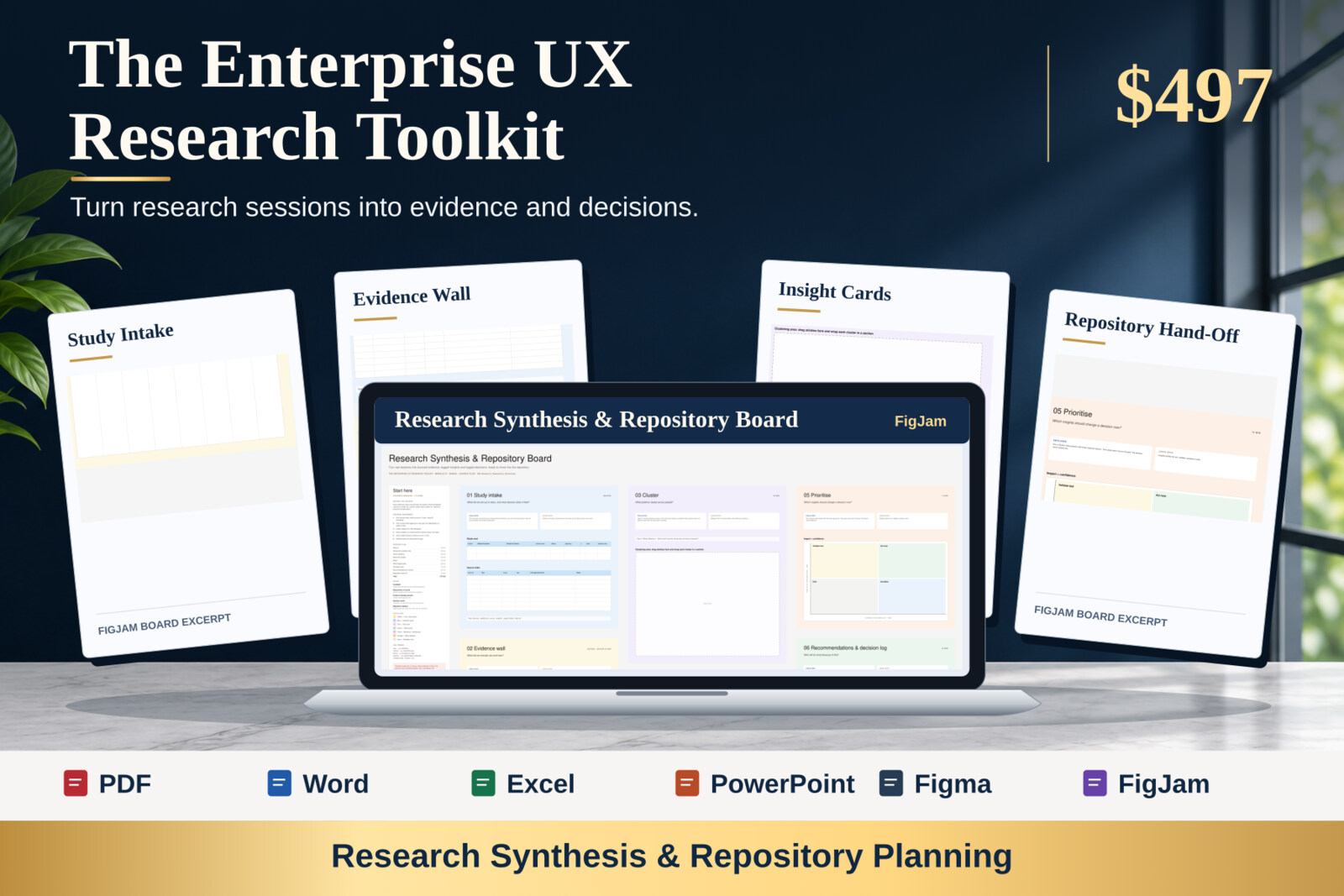
Research that survives an enterprise: intake and prioritisation, study design, recruiting at scale, synthesis, a repository people use, and evidence of impact.
Enterprise research does not fail for lack of method. It fails because the intake is political, the panel is stale, the findings live in a slide nobody opens, and nobody can prove the research changed a decision. This kit fixes the operating system around the method.
- Designed pages
- 65
- Editable files
- 36
- Modules
- 9
- Scored criteria
- 48
- Deliverables
- 10
One payment, no subscription. Your access key is emailed once payment clears. Invoice by card or bank transfer.
Who it is for
- Research leads and research ops managers building a function.
- Designers and product managers running research without a dedicated researcher.
- Consultants selling research programmes into large organisations.
- Teams with a repository nobody searches and a backlog nobody trusts.
The instrument
48 criteria across six dimensions
Strategy & Intake8
- A research strategy connects to product strategy
- An intake process exists and is visible to stakeholders
- Requests are prioritised against explicit criteria
- A rolling research roadmap exists
- Research questions are framed before methods are chosen
- Stakeholders know what research can and cannot answer
- Capacity is planned and communicated
- Research debt is tracked
Study Design8
- Method selection is justified against the question
- Sample and segments are defined deliberately
- Discussion guides are structured and piloted
- Tasks are realistic and non-leading
- Bias controls are built into the design
- Mixed-method triangulation is used where warranted
- Analysis approach is planned before fieldwork
- Ethics and consent are handled consistently
Recruiting & Panel8
- A participant panel exists and is maintained
- Screening criteria match the research question
- Recruiting timelines are realistic and tracked
- Incentives are compliant and competitive
- Accessibility needs are accommodated in recruiting
- No-shows and over-recruitment are managed
- Vendor relationships are governed
- Participant data is stored securely and lawfully
Analysis & Synthesis8
- Raw data is captured consistently
- Coding or tagging follows a shared scheme
- Findings are separated from recommendations
- Confidence and evidence strength are stated
- Contradictory evidence is reported, not smoothed
- Synthesis workshops produce decisions
- Insights are written for the audience that acts on them
- Findings are reviewed by a second analyst where stakes are high
Repository & Knowledge8
- A repository exists and is actually used
- Tagging and taxonomy are consistent
- Studies are findable by question, not just by date
- Permissions and confidentiality are enforced
- Insights are linked to decisions and outcomes
- Legacy research is curated, not dumped
- Search and summary quality are maintained
- Repository health is reviewed on a cadence
Enablement & Impact8
- Non-researchers are trained to run lightweight studies
- Templates and guides are available and current
- Research is present in product decision rituals
- Impact on decisions is tracked and reported
- Research is cited in roadmap and strategy documents
- Leadership sees a regular research summary
- Research quality is reviewed, not just volume
- The function has a credible point of view on its own value
The modules
Start Here
The research operating model and how to run the kit.
Strategy & Intake
Connect research to product strategy and build a trustworthy intake.
Study Design
Choose methods, define samples, and write guides that do not lead.
Recruiting & Ops
Panels, screening, incentives, accessibility and vendor governance.
Moderation Guides
Guides for generative, evaluative, diary and stakeholder interviews.
Analysis & Synthesis
Coding schemes, evidence strength and synthesis that produces decisions.
Repository & Tagging
A taxonomy and repository structure people actually search.
Enablement
Train the organisation to run lightweight research well.
Impact Measurement
Prove that research changed decisions, with numbers.
What you receive
- Research Operations Maturity Model — 48 criteria with scoring and roadmap
- Research intake form and prioritisation rubric
- Study design canvas and method selection guide
- Moderator guide library — generative, evaluative, diary, stakeholder
- Screener and recruiting tracker with accessibility accommodations
- Consent and ethics templates
- Analysis and coding workbook with evidence-strength scale
- Repository taxonomy and tagging standard
- Research impact tracker and quarterly summary template
- Stakeholder readout deck, editable
The complete practice
The Complete UX Consulting Business Bundle
Six kits, one purchase.
Six kits for delivering client-ready engagements across UX audits, AI transformation, design leadership, fractional consulting, healthcare UX, and research operations.
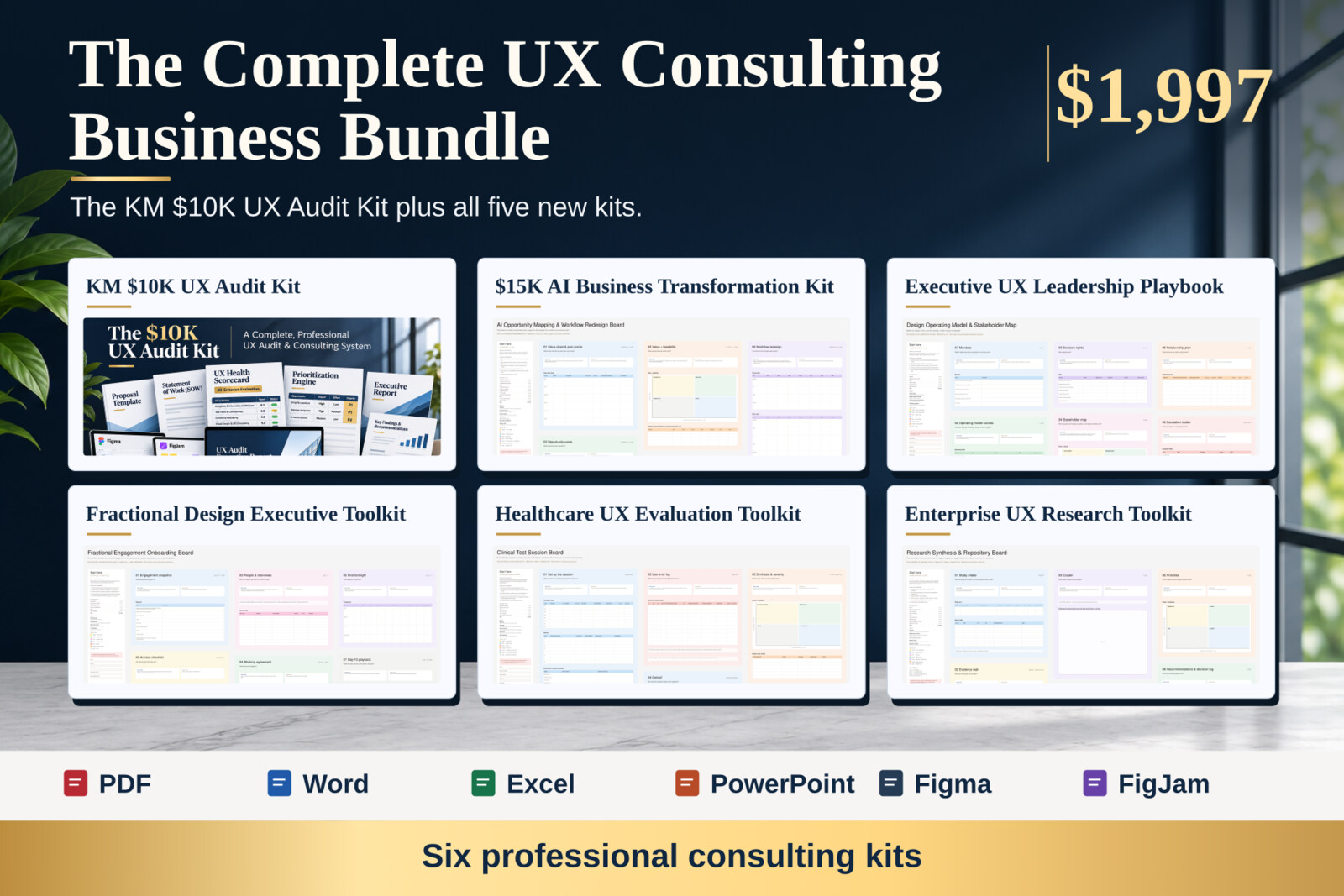
- UXThe $10K UX Audit Kit$497
- AIAI Business Transformation Kit$797
- EXExecutive UX Leadership Playbook$497
- FXFractional Design Executive Toolkit$697
- HCHealthcare UX Evaluation Toolkit$597
- RXEnterprise UX Research Toolkit$497
Bought separately: $3,582
Includes assessment scorecards, Excel scoring workbooks, editable Word proposals and reports, PowerPoint readouts, and worked examples.
Gumroad or Wave invoice or request a Wave invoiceSide by side
Which one do you need?
Page counts cover the PDF deliverables. The Design System Audit Kit includes 65 pages across ten numbered PDFs and a two-page quick reference. Its file count excludes the README. Editable files are the DOCX, XLSX, PPTX and Figma sources you can rebrand and reuse on client work.
| Product | Code | Price | Pages | Files |
|---|---|---|---|---|
| The $10K UX Audit Kit | UX | $497 | 102 | 35 |
| Design System Audit Kit | DS | $497 | 67 | 16 |
| AI Business Transformation Kit | AI | $797 | 65 | 15 |
| Executive UX Leadership Playbook | EX | $497 | 63 | 15 |
| Fractional Design Executive Toolkit | FX | $697 | 63 | 15 |
| Healthcare UX Evaluation Toolkit | HC | $597 | 66 | 15 |
| Enterprise UX Research Toolkit | RX | $497 | 65 | 15 |
| Complete UX Consulting Business Bundle | BD | $1,997 | Six kits | |
Before you buy
Look inside the $10K UX Audit Kit for free.
Six artefacts from the kit, published in full so you can judge the quality of the thinking before you spend anything: a sample audit report, the simplified health scorecard, the complete table of contents, screenshots of the editable templates, a sample client engagement workflow, and a line-by-line breakdown of every deliverable.
Open the free preview- A sample UX audit report, written end to end
- The simplified UX Health Scorecard, printable
- The complete table of contents, all seven modules
- Screenshots of every editable template
- A sample client engagement workflow, day one to handoff
- A breakdown of all 35 deliverables
Not sure which fits?
Tell me the problem. I’ll tell you the kit.
If you are weighing two instruments, or you need a version scoped to a specific industry or engagement model, write to me directly. I answer every message myself.

Keri Mitoff
Product Design Leader · Founder, Best Designer LLC