
Free preview · no email required
Look inside the clinical UX evaluation
before you spend $597.
Clinical software is not judged on delight. It is judged on whether a tired clinician at 3am, mid-task, with an interruption, can complete the right action without harming the patient. This preview publishes the whole evaluation instrument: a sample medication-reconciliation assessment, the safety and access scorecard with all fifty-six criteria, the complete contents, a six-week engagement and every deliverable. No form, no email address.
A sample clinical UX evaluation
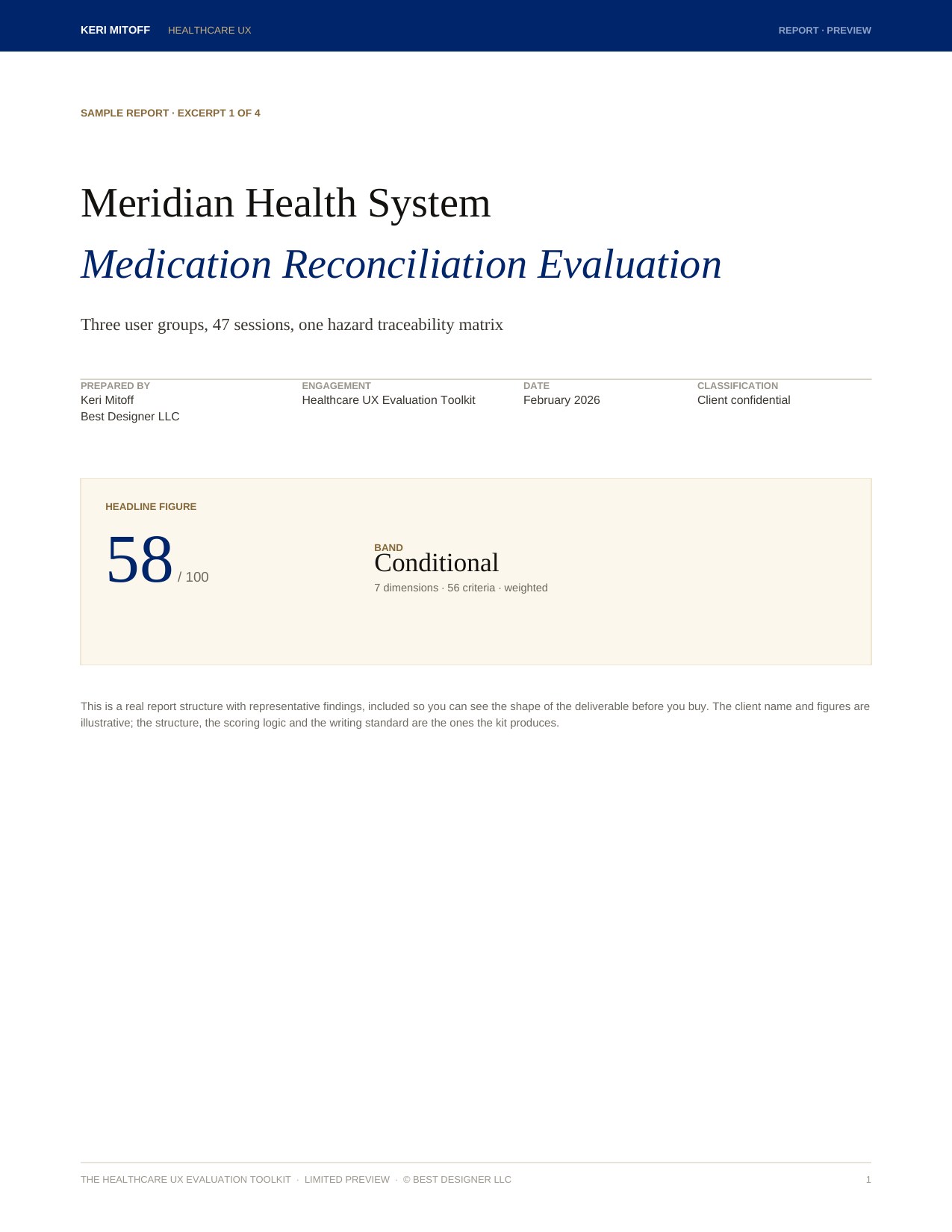
A complete evaluation of a fictional medication-reconciliation workflow, written to the standard the toolkit sets: every finding carries an evidence reference, a use-related consequence and a traceable severity.
- The cover, with the headline figure and the band it lands in
- Executive summary: what the assessment asks the client to decide
- The dimension profile, with the constraint named explicitly
- Five findings, each with evidence and consequence
- Scored against the same 56 criteria you get in the kit
This is a genuine excerpt. The full report structure — method, scope, limitations, recommendations and the roadmap appendix — follows the same shape inside the kit.
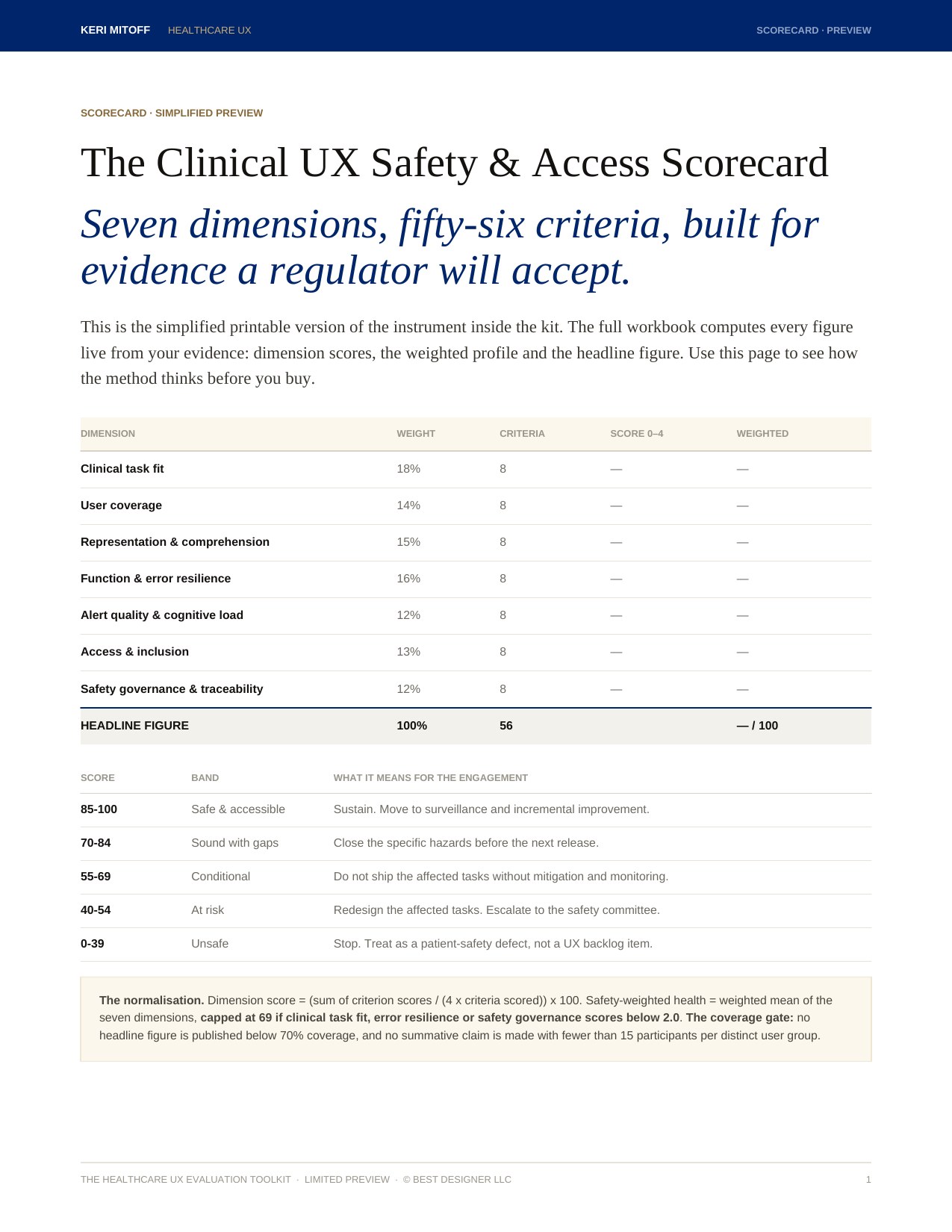
The simplified clinical ux safety & access scorecard
The instrument, printable, with all fifty-six criteria across seven dimensions and the safety-weighted model that caps a score when error resilience is weak.
- 7 dimensions with their real weights
- All 56 criteria, each with a 0–4 scale and an evidence field
- The 5 score bands and what each means for the engagement
- The normalisation formula, written out
- The published frameworks every criterion is traced to
Try it below. The interactive version scores a system in about a minute and shows you exactly how the weighted model behaves.
Try the model
Weighted · liveScore each dimension 0–4 and watch the weighted product health number move. This is the same arithmetic the workbook runs on 160 ratings.
The complete table of contents
Every file in the toolkit with its format, its page count and what it is for — the full contents, not a summary.
- 8 modules, from Start Here to the source-file bonus
- 34 files, each with format and page count
- 112 designed pages in total
- Every deliverable named, none held back for a higher tier
No hidden upsell. The contents page is the whole product. There is nothing reserved for a higher tier.
A sample client engagement
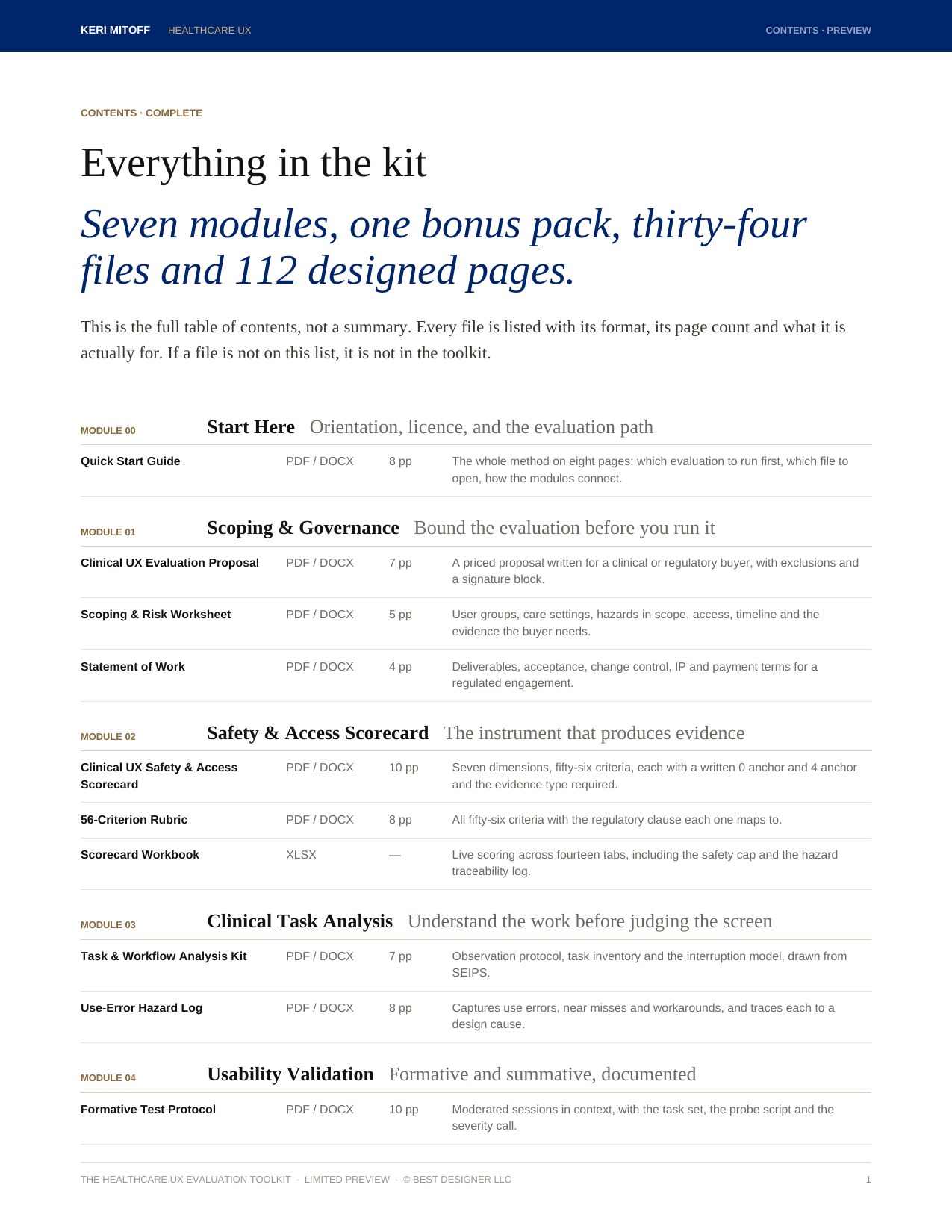
Six weeks, from scoped hazards to a traceability appendix a quality reviewer can sign — the sequence the templates assume.
- 4 phases: scope & risk, contextual fieldwork, validation, report & handover
- What you do and what you produce at each phase
- What the client sees, and when they see it
- The assumptions that make the timeline possible
This is the part most toolkits omit. Templates are easy; sequencing them so the engagement does not become a six-month programme is the hard part.
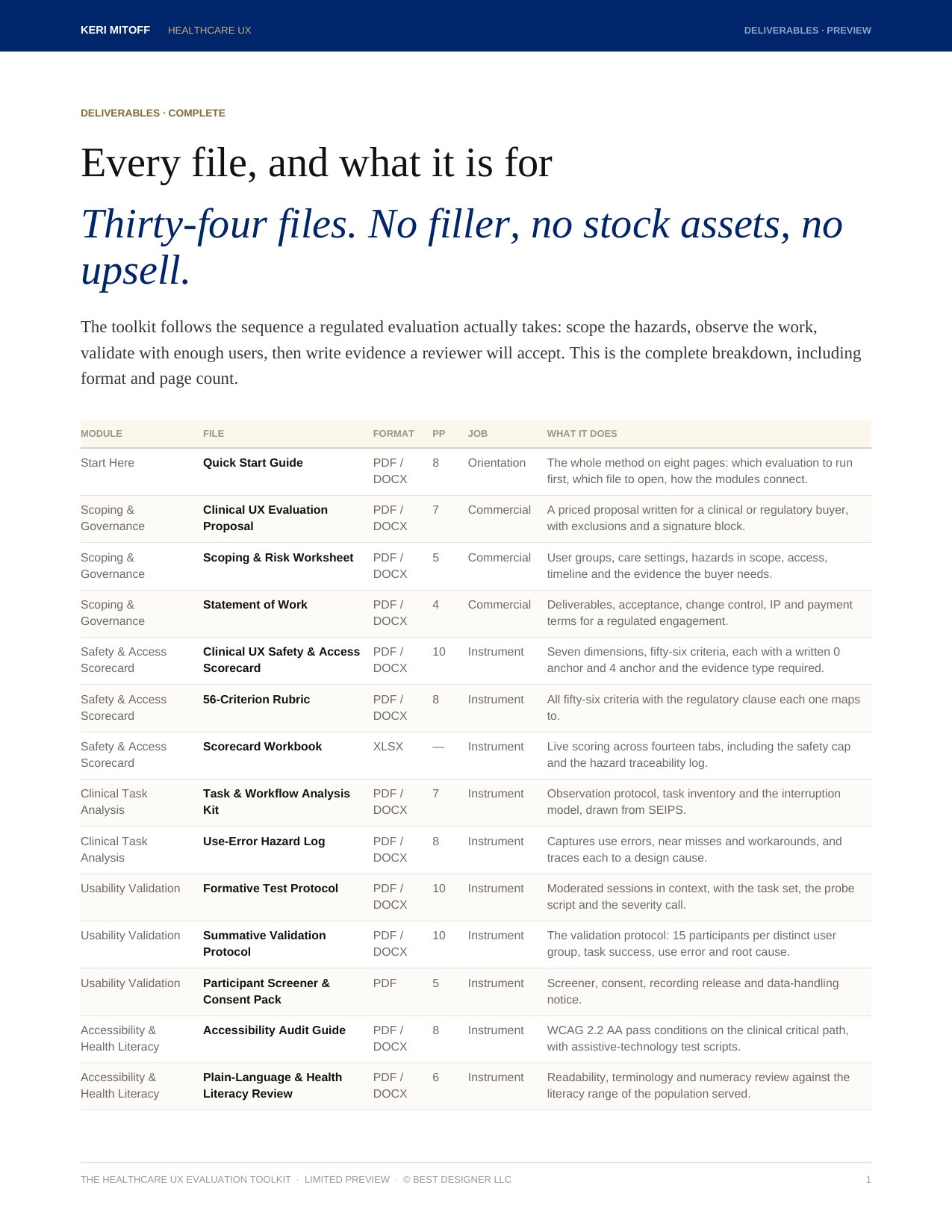
A breakdown of every deliverable
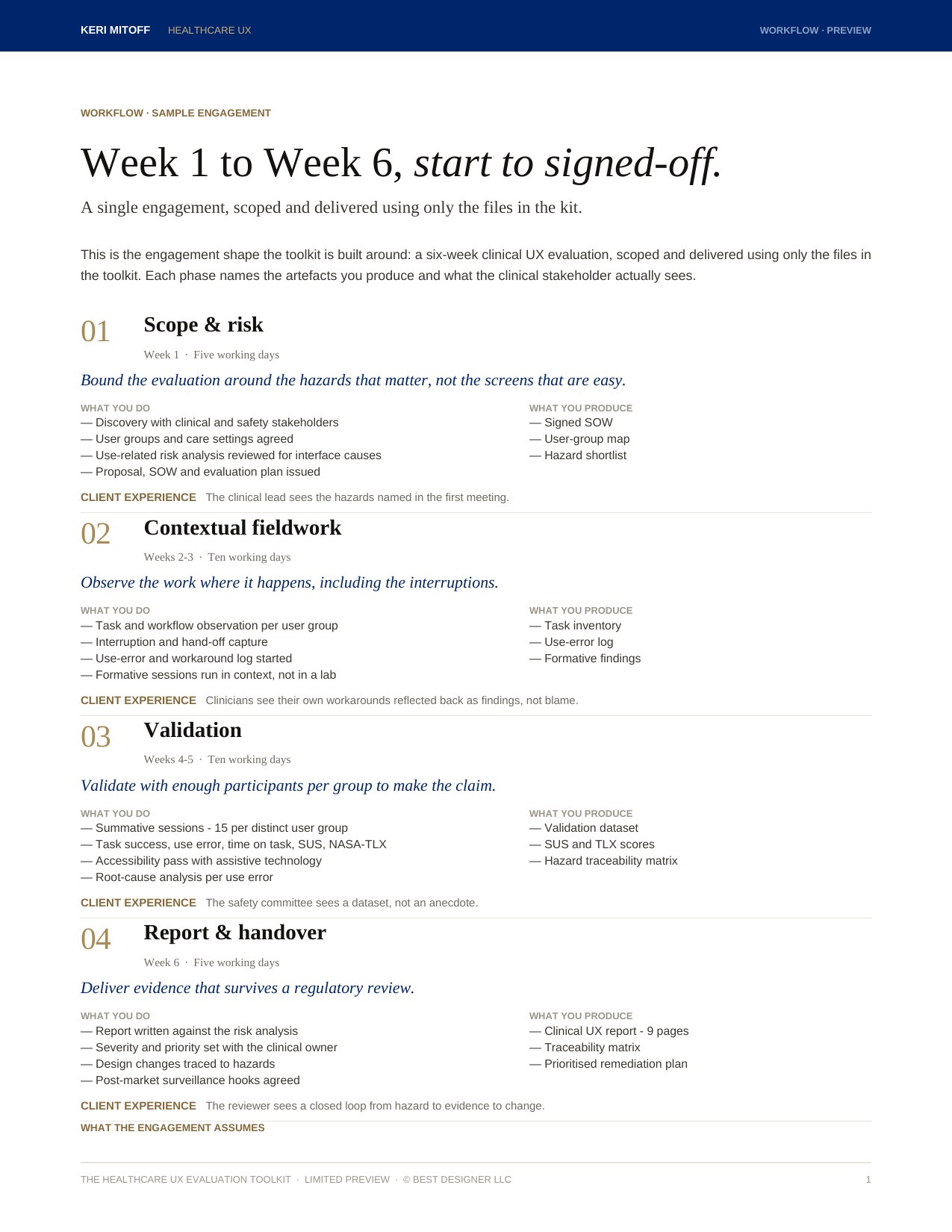
Thirty-four files following the order a regulated evaluation takes: scope the hazards, observe the work, validate with enough users, then write evidence that survives review.
- Every file, by module, with format and page count
- What each one is for, in a single line
- 34 files across 8 modules, nothing decorative
- Which PDFs have an editable counterpart
Everything is editable. Every PDF ships with a DOCX or XLSX counterpart, so the layout, the typography and the scoring model are yours to rebrand.
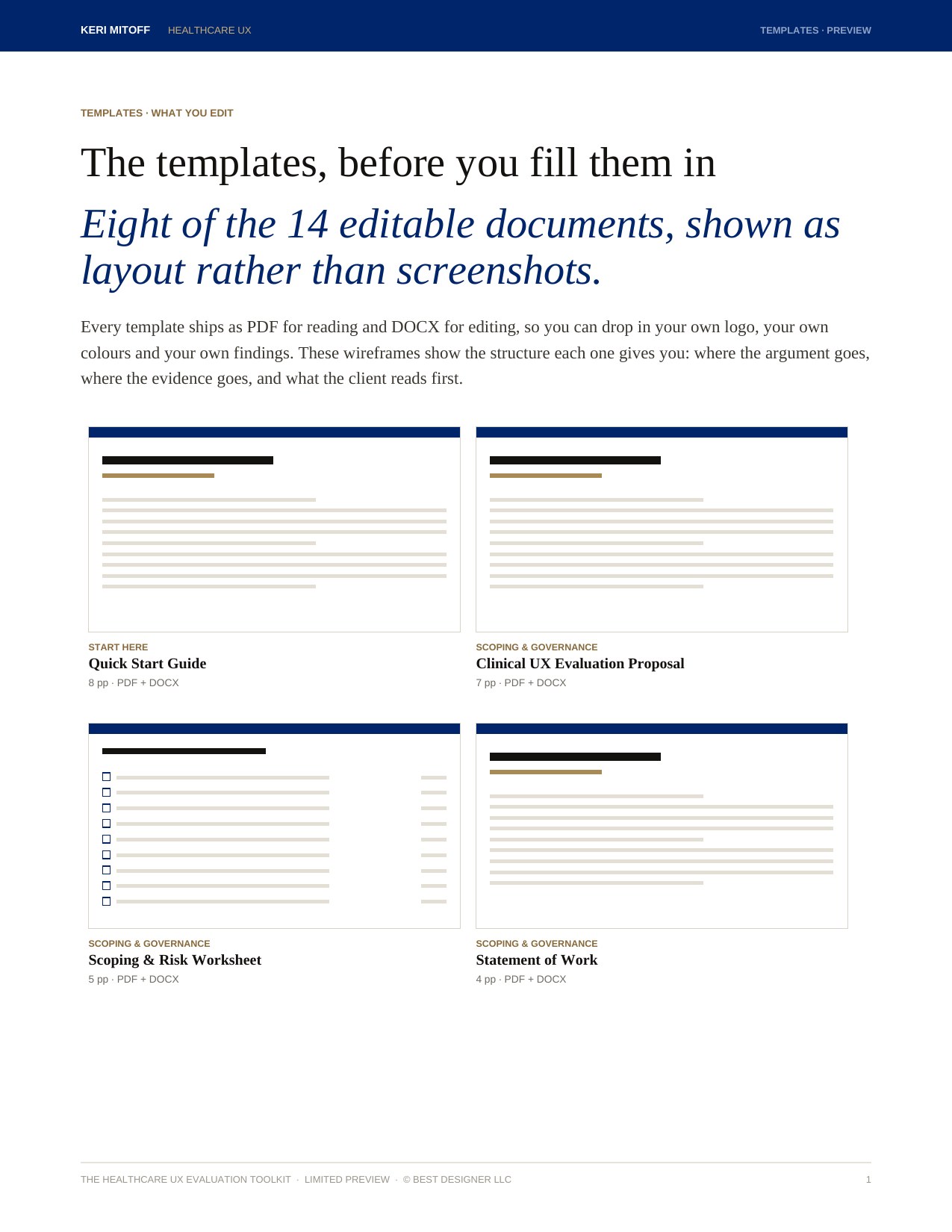
Screenshots of the editable templates
Eight of the editable documents, shown as layout. Every template ships as PDF for reading and DOCX for editing, so the structure and the audit trail are yours.
- Eight template layouts, drawn at page scale
- Same structure in PDF and DOCX — nothing breaks when you edit it
- Your logo, your colours, your findings in the same frame
- Where the evidence goes, and what the client reads first
Layouts, not screenshots. These are the actual page structures with placeholder text, so you can see how much room the argument takes before you buy.
Ready when you are
You have seen the method.
Now evaluate something that carries risk.
One payment of $597 for the complete evaluation toolkit — eight modules, thirty-four files and 112 designed pages — licensed for unlimited client and internal work. Built to produce evidence a regulator will accept.
- 8 modules · 34 files · 112 designed pages
- The Clinical UX Safety & Access Scorecard — 56 criteria
- Complete sample report and editable templates
- Source-file bonus pack included
- Unlimited client and internal use
- Card checkout or a Wave invoice